

.webp)
The Cost of PNDA
Contact
PNDA affects 1 in 5 mothers and 1 in 10 fathers in Australia, with psychological, social and physical factors increasing risk
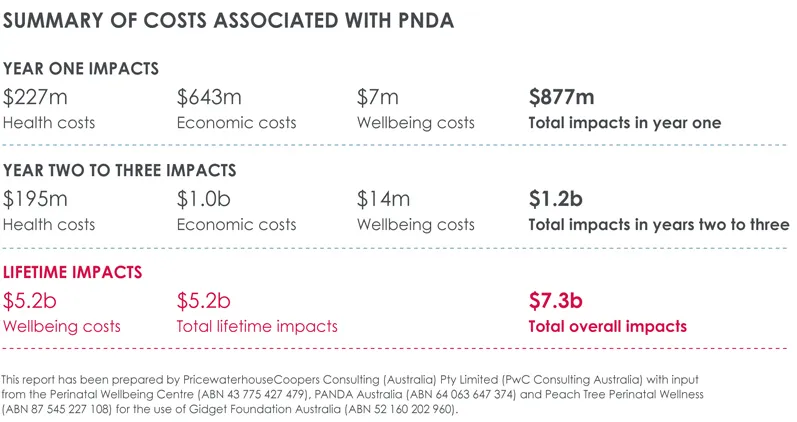
Perinatal depression and anxiety (PNDA) is costing Australia $877 million annually, according to a 2019 PwC Australia analysis prepared for Gidget Foundation Australia, entitled, ‘The Cost of Perinatal Depression and Anxiety in Australia’.
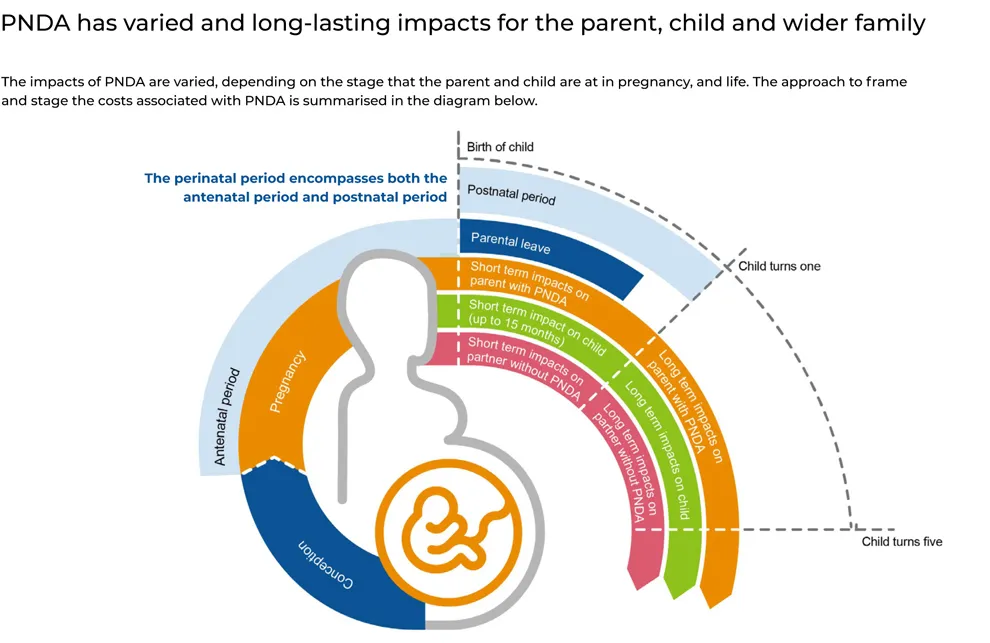
PNDA touches not only the parent experiencing the condition but can also have impacts on the child and wider family, with some of these impacts lasting a lifetime. Understanding the cost of PNDA to Australia can ensure that support for families be available during the critical early parenthood stage where it is needed. The estimated cost of PNDA to the health system, economy and wellbeing of those impacted totalled $877m, comprising of:
- health costs attributable to PNDA equalling $227m, comprising increased use of primary
and community health services and hospital health care services and increased risk of
certain conditions for both the parent and child - economic costs of $643m are attributable to productivity losses associated with
increased workforce exit, absenteeism, presenteeism and carer requirements - monetised social and wellbeing impacts include increased likelihood of developmental
issues, depression, anxiety and child ADHD diagnoses,
totalling $7m.
Beyond this are estimated lifetime impacts of $5.2b attributable to the increased risk of depression, anxiety and ADHD in the children of parents with PNDA, affecting wellbeing, productivity and health system use.
Download the media release here
Expressions of interest

Expressions of interest for the February 2025 program are currently open. To express your interest in the February 2025 program, click HERE to submit your resume and cover letter.
We strongly encourage applications from Aboriginal and Torres Strait Islander peoples.
The Cost of PNDA in Australia Report

FAQs
What does a client need to access the services of GFA?
In order to access our service, GFA requires the completion of a Gidget Foundation Australia online GP Referral and Mental Health Treatment Plan.
If you are a GP referring a patient to our service for the first time under Better Access, please complete the online GP Initial Referral and Mental Health Treatment Plan.
If you are a GP providing a re-referral for additional sessions, subsequent to those within your initial referral under their existing Mental Health Treatment Plan, please complete the online GP Re-Referral Form.
If you are a Third-Party Referrer providing a request for your client to access our services, please complete the online Collaborative Care Request*.
*This referral is not sufficient for clients to receive our Better Access service; a GP referral and Mental Health Treatment Plan will still be required.
What are the patient eligibility requirements?
Services are available to birthing and non-birthing parents throughout the perinatal period, from pre-conception through to 12 months postpartum, who have a diagnosis or are at risk of developing a perinatal mood and/or anxiety and/or stress related condition (such as PNDA), as well as experiencing birth trauma or pregnancy related loss (including stillbirth, miscarriage or termination), or experiencing difficulties with conception. Support is available for both first-time parents, and those who are welcoming another child.
The entire Gidget team provides care that is safe, effective and evidence informed within the parameters of the resources available to us. As a result, we are unable to accept referrals for people in crisis including those with:
- Current or enduring psychotic illness;
- Current serious suicidal, homicidal or infanticidal ideation;
- Current serious substance abuse that requires medical intervention;
- Current child protection and/or family violence or issues requiring Department of Communities and Justice involvement.
If we receive a referral that includes any of the above, Gidget Foundation Australia will notify the person’s GP so they can refer to a more suitable service.
Who should I address my referrals and MHTPs to?
Please address referrals to Gidget Foundation Australia or "Dear Clinician" unless you have a specific reason to request a particular clinician type.All Gidget Foundation Australia clinicians hold additional mental health training and experience, and include Clinical Psychologists, Registered Psychologists, Mental Health Accredited Social Workers, and Mental Health Accredited OTs. Using a non-specific addressee allows greater flexibility in client placement, reducing barriers to care and enabling faster access to our services.
Do we accept a chronic disease Management plan (CDM)?
Gidget Foundation Australia does not accept CDM plans. As a perinatal mental health service, we operate under the Better Access framework — CDM plans are intended for psychological care related to chronic physical conditions and are not applicable to our client group.
What can my patient expect once the Referral and Mental Health Treatment Plan have been completed?
On receipt of the GP referral and Mental Health Treatment Plan, your patient will receive a request to complete a ‘Client Information Form’. Please advise your patient that they are welcome to contact 1300GIDGET if they need assistance in completing it. We are always happy to help.
Once all paperwork is received, your patient will go through to intake. Occasionally we may reach out to the referrer or client for more details. All patients will be contacted for next steps.
If anything changes for your patient during this interim period and you need to contact us on their behalf, please call 1300GIDGET and request to speak with the Clinical Intake Team
What is the waitlist process?
When there is availability with a Clinician, at the preferred location, the next client on the waitlist will be contacted and we will proceed to book them into the GFA Clinician diary for psychological support.
What are the National Perinatal Mental Health Guidelines?
The National Perinatal Mental Health Guidelines were reviewed and updated in 2023. The scope of the National Guideline includes the assessment of the high prevalence disorders and the treatment and management of these, together with severe mental illnesses in primary care settings. New additions to the 2023 Guideline include screening and psychosocial assessment for fathers and non-birthing partners and the management of psychological birth trauma.
Disorders covered in the Guideline include:
- Depression
- Anxiety
- Bipolar Disorder
- Puerperal Psychosis
- Schizophrenia (new)
- Borderline Personality Disorder (new)
How to screen and assess for PNDA?
The Edinburgh Postnatal Depression Scale (EPDS) is a commonly used screening questionnaire in the perinatal period with a standard scoring guide.
Gidget Foundation Australia supports those experiencing mild to moderate perinatal depression and anxiety. If your patient answers 1 or more on Q10 relating to self-harm and this is current or they have an EDPS score of higher than 14, we ask for careful consideration as to whether they require a more acute service. We encourage you to contact our Program Clinician on 1300 851 758 to discuss the individual needs of your patient and their suitability for our service. The Depression, Anxiety and Stress scale 21 items (DASS 21) is a set of three self-report scales designed to measure the emotional states of depression, anxiety and stress. A scoring guide is also available.
GFA supports those experiencing mild to moderate perinatal depression and anxiety. If your patient’s score on the DASS 21 is ‘severe’ (as defined in the scoring guide), we ask for careful consideration as to whether they should be referred to a more acute service. We encourage you to contact our Program Clinician on 1300 851 758 to discuss the individual needs of your patient and their suitability for our service.